Praying with Peter

A Pastoral Letter to the Church of Denver
J. Francis Stafford
Archbishop of Denver
30 May 1993
The Solemnity of Pentecost
1. To the Church of Denver, “to those who have obtained a faith of equal standing with ours in the righteousness of our God and Savior Jesus Christ: may grace and peace be multiplied to you in the knowledge of God and of Jesus Christ” (2 Peter 1:1-2).
Dear Brothers and Sisters in Christ:
2. In August, the Church of Denver will welcome Pope John Paul II and thousands upon thousands of young people as they continue their pilgrimage here in Colorado to the great Jubilee of the year 2000. Just as in Jerusalem on the first Pentecost, young men and women from around the world, speaking in dozens of tongues, will join in the new song of praise during World Youth Day 1993, giving thanks in the unity of the Spirit for the “mighty works of God” (Acts 2:12). Here, the Church of Denver and its guests, who together are “a chosen race, a royal priesthood, a consecrated nation” (1 Peter 2:9), will experience the grace of the Risen Lord who says to us all, “Be holy, for I am holy” (1 Peter 1:15). Here, we shall be “living stones” who together will be “built into a spiritual house” (1 Peter 2:5).
3. To host this Eighth World Youth Day Celebration is a great privilege and a special moment of grace for the Church of Denver: an opportunity for a deepened interiority (The Pastoral Constitution on the Church in the Modern World, 14) and a time to allow the Catholicity of the one Church to manifest itself in the richness of the faith in Jesus Christ of this local Church. Over the past decade, the young people of today—the leaders of the Church and the world of the 21st century—have met and prayed with the Holy Father in Rome and Buenos Aires, at the great shrine of Santiago de Compostela in Spain, and at the historic Polish monastery of Jasna Gora in Czestochowa, the home of the icon of the Black Madonna. As Pope John Paul II himself has said, these meetings are “providential opportunities to break our journey for a while” in order to see with new eyes the splendor of God in the face of Christ. Now, together with the successor of Peter the Apostle, the great evangelist of the first Pentecost, the young people of the world will come to the Rocky Mountains, the backbone of the North American continent. Here, we shall embody the unity of the universal Church, gathered in the power of the very same Spirit who came upon the apostolic Church in the Upper Room (Acts 2:1–4). Together with Peter in the person of his successor, the Bishop of Rome, we shall celebrate with the bishops and our other brothers and sisters from North America, Latin America, Australia, Africa, Asia, and Europe the promise given by our Lord, a promise that speaks to the deepest yearnings of the human heart: “I came so that they might have life, and have it abundantly” (John 10:10).
4. This quest for abundant life is most assuredly not for Roman Catholics alone. Rather, it is a quest in which we shall be joined by other Christians and indeed by all men and women of good will. World Youth Day is thus an opportunity for all of us in Denver and throughout Colorado to reflect on the great gift of life, on the great cause of human freedom, and on the great task of defending the God-given dignity of all human beings.
5. Our experience as hosts of World Youth Day reminds us of the sisters of Bethany, Martha and Mary. Like Martha, we are “anxious and troubled about many things,” not least the details of hospitality; like Mary, we want to choose the “good portion,” to sit at the feet of Jesus the Lord and listen to His teaching (Luke 10:38–42). That the Church ranks Martha among her saints is a reminder that the welcome we extend to our guests is a grace-filled event. That Mary's was the “good portion” reminds us that World Youth Day is first and foremost a time of prayer and contemplation, an opportunity for friendship and love, a time of entering deeply into the Paschal Mystery by tasting more fully the fruit of the Spirit: “love, joy, peace, patience, kindness, goodness, faithfulness, gentleness, self control” (Galatians 5:22–23).
6. Moreover, our prayer and contemplation together in August will have a special character, for we shall be praying together with Peter in the person of his successor, Pope John Paul II.
The Holy Father does not come to us as a stranger. For almost fifteen years now we have seen his face in our newspapers and magazines, heard him on radio and television, journeyed with him on his apostolic missions throughout the world, read his encyclicals, celebrated with him the twentieth anniversary of the completion of the Second Vatican Council. But at a far deeper level, the Holy Father is no stranger to the Church of Denver because for every day of those past fifteen years we have re-affirmed our communion with Peter by praying in the Eucharist for the Bishop of Rome—for the bishop who leads the apostolic church of Peter and Paul. That Eucharistic prayer has united us with the local churches throughout the world; and it has united us, as it unites them, in a blessed intimacy of love with Pope John Paul II who, in his apostolic office, is a sign of the Church's unity in her Lord. In August, we do not welcome a stranger; we welcome a beloved father in Christ, for whose ministry of evangelization, reconciliation, and unity, we make intercession every day.
7. On this Pentecost, then, as we eagerly anticipate World Youth Day, let us lay aside for a moment the cares of Martha and take up the “good portion” of Mary. Let us reflect on what it means to pray with Peter for the Church and for the world, as the Body of Christ and the whole human family prepares for the Jubilee of the 2,000th anniversary of the Incarnation of Christ.
PETER, THEN AND NOW
8. The apostle Peter is the most intensely human figure among the Twelve chosen by the Lord as the foundation stones of the New Jerusalem (Revelation 21:14). Impulsive, abrupt, sometimes prescient, sometimes obtuse, weakened by fear and strengthened by love, “Simon, whom he named Peter” (Mark 3:17), models for us the struggles and the glories of discipleship. In Simon Peter's confession at Caesarea Philippi—”You are the Christ, the Son of the Living God” (Matthew 16:16)—we find a model for, and reminder of, what our own confession of faith should be. In Peter's fear-driven denial of Jesus (Mark 14:66–71), we see mirrored our own sinfulness. In Peter's repentance (Mark 14:72), we taste with him the bitter ashes of remorse. And in Peter's humble, urgent insistence to the Risen One, “Lord, you know everything; you know that I love you” (John 21:17), we see reflected our own restoration to grace by the power of the Lord's death and resurrection.
9. Because Peter's was a rich and complex personality, there is no one image that fully captures all the qualities of his discipleship. Rather, in the New Testament we discern a tapestry or pattern of Petrine images that have influenced the Church's perception of Simon Peter, the first of the apostles, and the Church's understanding of Peter's successors in that apostolic ministry, the bishops of Rome.
10. In the Gospels of Matthew, Mark, and Luke, and in the Acts of the Apostles, Peter is often portrayed as the great Christian fisherman, the great missionary. Called with his brother Andrew on the shores of the Sea of Galilee after the miraculous catch of fish, and assured that “henceforth you will be catching men,” Peter “left everything” to follow Jesus (Luke 5:10–11). Peter boldly proclaimed the Gospel in Jerusalem after the resurrection (Acts 2:14–41), healed the sick and the lame “in the name of Jesus of Nazareth” (Acts 3:6), and brought into the household of faith its first Gentile convert, the Roman centurion Cornelius (Acts 10). Peter's personal witness to the Risen Lord and to the power of the Spirit, was the chief means by which he fulfilled the Lord's injunction at the Last Supper to “strengthen your brethren” (Luke 22:32).
11. In the Gospels of Matthew and John and in the First Letter of Peter, the apostle is presented as the shepherd or pastor of the sheep. After Peter's confession at Caesarea Philippi, Christ gives to Peter “the keys of the kingdom of heaven” (Matthew 16:19); and to Peter, in his encounter with the Risen One on the shoreline where Simon Bar-Jona was first called, is given the responsibility, “Feed my lambs...tend my sheep...feed my sheep” (John 21:15–17). Peter's authority is an authority of love: it is the intensity of his love for the Lord that places him first among those called and sent. And it is because of this love, which is both a “witness [to] the sufferings of Christ” and a partaking “in the glories to be revealed” (1 Peter 5.1), that Peter the elder can lead other elders in their care for the flock of the Lord.
12. That leadership, as the Lord Jesus made clear in his discourse on the Good Shepherd, requires that those charged with feeding and tending the Lord's flock be prepared to lay down their lives for their sheep (John 10:11), to be bound and led “where you do not wish to go” (John 21:18). Thus, by an ancient tradition of the Church, reflected in these New Testament scriptures, Peter was a prototype of the Christian martyr. But his martyrdom was not a tragedy; rather, it was the great witness for which the Lord destined him, the witness by which Peter and many other confessors of the faith would “obtain the unfading crown of glory” (1 Peter 5:4).
13. According to another image of Peter in the New Testament, the apostle is equipped for his ministry by receiving the favor of special revelations of the glory of the Lord. Thus Peter, with James and John, is witness to the raising of Jairus's daughter (Mark 5:21–24, 35–42) and to the Lord's Transfiguration on Mt. Tabor (Mark 9:2–8); Peter is the first of the apostles to see the Lord after his resurrection (1 Corinthians 15:5; Luke 24:34); Peter is given visionary guidance as he baptizes the Gentile centurion Cornelius and his family (Acts 10:9–16); and Peter's vision of an angel precedes his miraculous release from prison in Jerusalem (Acts 12:7–9). But these privileges are not bestowed arbitrarily; rather, they are related to Peter as the first confessor of the faith, the first to proclaim Jesus to be “the Christ, the Son of the living God.” Thus Peter's flashes of insight, Peter's preaching, Peter's healing, and Peter's leadership are all expressions of Peter's faith in Christ and Peter's love for the Lord. And in service to that Lord and as an expression of that love, it is Peter's task to interpret prophecies and to guard the faith against false teaching (2 Peter 1:20–21, 3:15–16).
14. The very name the Lord Jesus gave to Simon the fisherman captures the essence of the images of Peter in the New Testament, and points us beyond Biblical times to the Petrine ministry exercised by the bishops of Rome. In antiquity, names were not simply labels; names expressed the nature and function of men and women. Thus when Jesus says to Simon after his confession of faith, “Blessed are you, Simon Bar-Jona...You are Peter, and on this rock I will build my church,” the name, “Peter” (Petros, in Greek), and the function, to be the sturdy foundation of the Church and its unity (petra, “the rock,” in Greek), are one and the same. Simon is “Peter” because his person is the rock on which the community of the faithful will stand, and stand so firmly that “the powers of death will not prevail against it” (Matthew 16:17–18). It is Peter upon whom the Lord has built the Church as upon a living foundation and who supports the whole building of the Church. It is blessed Peter who does not cease to preside over his own see. One should note with what hardness Jesus forms Peter to make him “the rock.” Jesus spares him no severity, no humiliation (e.g., Mt. 16:23). The Lord's commission to Peter after the resurrection, in the instruction to “feed my sheep,” confirms the Petrine ministry, whose authority was recognized by Paul (Galatians 1:8; 2:7–9) and the apostolic community.
15. Peter's distinctive mission to “strengthen the brethren” (Luke 22:32) has an abiding significance for the Church. And as Peter gave his greatest witness to the faith by his martyrdom in Rome during Nero's persecution, the ministry and office of the Bishop of Rome embodied this enduring “Petrine responsibility” in the Christian community. The ways in which the bishops of Rome have exercised that responsibility have changed over the two millennia of Christian history. But the essence of their task has remained the same: to be the rock, the rock-solid foundation, on which disciples of all times can stand. Thus the pope, the successor of Peter who was first among the witnesses to the grace and mercy of the Risen Lord, is first of all the servant of all; the “servant of the servants of God,” is one of the ancient titles of the pope which endures to our day. And he exercises that service by living out in his papal ministry the enduring reality of Peter as the “lasting and visible source and foundation of the unity both of faith and of communion” in the Church (Dogmatic Constitution on the Church, 18).
In his service to the communion of faith and love, the pope is the sentinel on watch who both retains the memory of the apostolic faith and remains alert to the struggles of the people of God in discerning the signs of the times. In certain circumstances, the pope exercises his power to guarantee without mistake that a truth belongs to the apostolic faith. The Roman pontiff is infallible when, in solemn judgement, he defines for the universal Church a question of faith or morals.
16. The Church of today needs Peter as the Church of Jerusalem did on the first Pentecost. Indeed, as the Church has become ever more humanly diverse over the centuries—thanks to the grace of God at work through the growth of local churches—the Church's need for Peter, for a visible ministry of unity, has grown even greater. Through Peter's successors, together with the bishops of the local churches, the successors to the apostles, the universal Church on whose Eucharistic celebration the sun never sets can speak and act concretely, in witness to the Gospel and in service to the world. With Peter's successors, in union with the Catholic bishops of the world, men and women of every race, tongue, and nation are linked in a Spirit-guided succession to that apostolic community of almost two millennia ago, the community that was “filled with the Holy Spirit” who descended on them as “tongues...of fire” (Acts 2:3). In the communion of the Church with Peter's successors, men and women “from every nation under heaven” (Acts 2:5) can see embodied today “the unity of the Spirit in the bond of peace” (Ephesians 4:3).
17. The Bishop of Rome exercises his Petrine ministry and office as part of the one and undivided episcopate and as an expression of the Church's unity in Christ. Thus the Bishop of Rome is both father and brother to those whom he is commissioned to feed and strengthen: he is our father in Christ and our brother in Christ. For us, he is the foundation stone of the unity of the Church amidst its splendid diversity; with us, he is a member of the communion of saints which extends through time and space. Like the bishops of Rome from the earliest days of the Church, he has a special love and care for all the local churches; and he exercises that universal pastorate precisely because he is the bishop of the apostolic see of Peter and Paul. His ministry and office are essentially related to the glorious witness of these two Coryphaei (the two “witnesses” or “leaders”). In welcoming Pope John Paul II to Denver we are welcoming Peter; and in welcoming Peter we are affirming our communion with the universal Church of which Peter is the visible head.
18. The increasingly radical rejection of the teaching authority of the pope, which has intensified since 1968, has been a great tragedy for the Church in the United States. It plays into the worst tendencies of our culture, anarchical individualism. Indeed, what can reasonably be called a deep-seated, anti-Roman bias in some parts of the Church requires all of us to reflect carefully on the profound, fruitful mysteries of communion, fidelity, and obedience in the Body of Christ which is the Church. The teaching authority of the popes—the papal magisterium—is the custodian of the memory of the Church. Those who dissent from the authority of that teaching—in order to get “beyond good and evil,” beyond the distinctiveness of being male and female, beyond the sacredness of human life, beyond any objective norm of morality—are thus engaged in an intentional act of forgetting: a profound lapse of memory. It is the divinely mandated mission of the Church's teaching authority to call us to a deeper anamnesis, a deeper memory, and a deeper appropriation of the mysteries of God in Christ. And thus we must all work, in charity, to overcome the climate of what some style ‘The American Religion,’ that cuts us off from the living memory of the Church as that memory is expressed in the teaching authority of the magisterium, especially of the papal magisterium.
The opening Mass of World Youth Day will take place on the Feast of St. Clare of Assisi, when we shall remember the 800th anniversary of her birth. St. Clare's life and teaching can be a guide to us in a time of ecclesial tension. For she asked that all should reverence the pope; and she specifically called her sisters at San Damiano to a life of community which Catholics today can emulate: a life in which we work together to preserve the “unity of mutual love, which is the bond of perfection.”
A MAN FOR THIS SEASON
19. Underneath St. Peter's Basilica in Rome are the scavi, the excavations begun by Pope Pius XII to explore the ancient Christian cemetery in which, according to tradition, Peter was buried. But far beyond the archaeological fascinations of the journey, a pilgrimage through the scavi is a striking experience of God's reverence for particularity, which is part of the “scandal” of Christianity (1 Corinthians 1:23). We now know, with as much certainty as is possible in these matters, that the traditional site of Peter's burial was in fact the place where Simon Bar-Jona came to his final earthly rest. We know that near this spot the fisherman who walked the shores of the Sea of Galilee, who left everything to follow an obscure preacher, who worried about his mother-in-law's health and fretted over his own place in the Kingdom to come, who betrayed his master and was forgiven because of his great love, who was given the keys of the kingdom of heaven by the incarnate Son of God--here, this man met his death in crucified imitation of the Lord, probably facing the great obelisk of the ancient Caesars that we see today in St. Peter's Square. Here we can touch the intersection of salvation history and the history of one man: a man like us, as he told the centurion Cornelius (Acts 10:26). Here, we can discern the mysterious ways of our God, whose treasures of grace and glory are borne in the earthen vessels of our humanity (2 Corinthians 4:7). Here, we are reminded that Christianity is not a story constructed by human beings, but the story of God at work among us, in the real lives of real men and real women who know that while “we live, we are always being given up to death for Jesus' sake, so that the life of Jesus may be manifested in our mortal flesh” (2 Corinthians 4:11).
20. In every age of the Church, the Spirit raises up great witnesses who, precisely in their particularity and uniqueness, embody the abiding truth of the Christian faith and bring that truth alive in a forceful way for their own time. Our guest, Pope John Paul II, is such a great witness. Called to Rome “from a far country,” as he put it on the night of his election, John Paul II has travelled across an extraordinary expanse of this earth, bringing to each person “the light of the knowledge of the glory of God in the face of Christ” (2 Corinthians 4:6). His confident hope in the power of the Lord and the promises of the Spirit has decisively shaped the history of nations; for Pope John Paul II was a chief architect of the revolution of conscience that made possible the nonviolent overthrow of communism in central and eastern Europe. But this pope has ever been, first and foremost, a pastor and an evangelist. His first concern is to strengthen the brethren by preaching the Gospel, and his first pastoral care is for the unity of the flock of Christ.
21. Yet even though his is perhaps the most familiar face on the planet, many of us know little about this 263rd successor of Peter: about his early years, his pastoral experiences, his accomplishments as a philosopher, his zest for the life of the outdoorsman. As we prepare to welcome the Holy Father, I should like to tell you about this man who exemplifies the grace of God working through the particularities of our lives, and I should like to try to grasp the heart of his evangelical message.
22. Karol Jozef Wojtyla was born in Wadowice, a town some thirty miles southwest of Krakow, on May 18, 1920. His father was a retired officer of the Austro-Hungarian army; his mother, who died before young Karol made his first communion, was of Lithuanian descent. An older brother died as a young man. A fine student, active sportsman, and amateur actor, Karol Wojtyla graduated from the public high school in his hometown and then moved with his widower father to Krakow, where in 1938 he began his studies in Polish language and literature in the ancient Jagiellonian University, once home to Copernicus. There, in the archway over the university's Collegium Maius, he found the Latin motto, Plus ratio quam vis: “Reason rather than force.”
23. His studies were brutally disrupted by the Nazi invasion of Poland in September 1939; the university was closed and its professors imprisoned in the Sachsenhausen concentration camp, where many later died. The young Wojtyla worked as a manual laborer in a stone quarry, and later in a chemical plant. At this time while reflecting upon the evils of totalitarianism, he began writing a series of plays which are still being published and produced in various countries.
Meanwhile, his father died in February 1941, and twenty-year-old Karol was left alone, in a country under Nazi occupation. He participated in a number of underground literary, dramatic, and religious groups; with other members of the resistance, he helped save Jewish families from their Nazi hunters. It was during this period that his vocation to the priesthood crystallized under the guidance of a lay mystic and tailor, Jan Tyranowski. Later, as pope, John Paul II would describe this leader of the “Living Rosary” prayer group as a “real master of the spiritual life” who exemplified “a new world that I did not yet know”: the world of a “life given entirely to God alone.” Thus in late 1942 Wojtyla joined the underground seminary organized by the Archbishop of Krakow, Adam Sapieha. And because his name was on a Nazi “wanted” list, he lived in hiding in the archbishop's residence during the last years of the war.
24. Karol Wojtyla was ordained a priest by Archbishop Sapieha in 1946. The archbishop then sent him to Rome for advanced theological studies, during which he developed his longstanding interest in Christian mysticism in a doctoral dissertation on St. John of the Cross. Returning to Poland in 1948, he was assigned to parish duties, which he pursued with a special care for young people. In 1954 he received a second doctorate, in philosophy, concentrating on the work of an early German proponent of phenomenology, Max Scheler. He began to teach part-time in the Catholic University of Lublin, the only Catholic institution of higher education behind the Iron Curtain. During the 1950s (and indeed for many years after), Father Wojtyla continued to write poems, plays, and essays, sometimes published under a pseudonym. In 1958 he was consecrated as auxiliary bishop of Krakow, the youngest bishop in Poland; notification of his nomination as bishop came to him when he was on a canoeing trip with some young people.
25. Archbishop Wojtyla, who succeeded to the see of Krakow in 1964, was an active participant in all four sessions of the Second Vatican Council, between 1962 and 1965. He made major contributions to Gaudium et spes, the Pastoral Constitution on the Church in the Modern World, especially in its discussions of contemporary atheism and modern labor. But it was Dignitatis humanae, the Declaration on Religious Freedom, that was the centerpiece of Archbishop Wojtyla's efforts at Vatican II. The declaration had obvious importance for the persecuted Church in communist lands. But Wojtyla believed that the declaration in fact spoke to the Church throughout the world. By affirming that God wishes to be adored by the free assent of the human mind and heart, and by teaching that the human intellect and will are ordered to the truth, the Declaration on Religious Freedom affirmed a distinctive Christian humanism that could challenge the false humanisms propounded by Marxism-Leninism in the East and skeptical relativism in the West.
26. Archbishop Wojtyla was named cardinal by Pope Paul VI in 1967 and participated in all the meetings of the international Synod of Bishops established by the Council. In 1969 his major philosophical work, The Acting Person, appeared in Polish, and in 1975 and 1976 he lectured on the subjects discussed in the book at major universities throughout the world, including Harvard University and The Catholic University of America in Washington, D.C. In March 1976, Cardinal Wojtyla preached the Lenten retreat for Pope Paul VI and his collaborators. Those meditations, subsequently published as Sign of Contradiction, display the depth of Karol Wojtyla's spirituality and the range of his reading—in their extensive meditation on Biblical themes, and in their references to Irenaeus, Augustine, Aquinas, Pascal, de Lubac, Ricoeur, and Rahner among the philosophers and theologians, and to Milton, Shakespeare, and Saint-Exupery among the poets. Later that same year, Cardinal Wojtyla represented the Polish Church at the Eucharistic Congress held in Philadelphia.
27. On October 16, 1978, the College of Cardinals elected Cardinal Karol Jozef Wojtyla as Bishop of Rome. Like his predecessor, John Paul I, Pope John Paul II declined the papal tiara and was installed in an outdoor celebration of the Eucharist in St. Peter's Square. On that solemn and festive occasion, he preached on the two great themes that would shape the Petrine ministry for the next fifteen years. To those who were persecuted or pressured for their faith, overtly in communist lands or subtly in secularized societies, he proclaimed, again and again, “Be not afraid!” To the persecutors, and indeed to all who had convinced themselves that the liberation of men and women depended on the rejection of God, he urged, “Open the doors to Christ!”
28. John Paul II's evangelization has touched on an extraordinary range of topics; yet his catechesis has in fact been characterized by a holy simplicity. It is a Christological simplicity, for whether he is addressing scientists or peasants, statesmen or athletes, young people or grandparents, the Holy Father constantly weaves variations on the one great theme that framed his inaugural encyclical, Redemptor hominis: Jesus Christ! Christ alone reveals both the face of the Father and the true meaning of humanness; Christ reveals both God's salvific will and the glorification of humanity that was intended by the Creator in the creation. “Through the Incarnation, God gave human life the dimension that he intended [for it] from [the] beginning” (Redemptor hominis, 2). Put another way, John Paul II has gently but urgently insisted that Jesus Christ is the dramatic answer to the radical question that is every human life and every human story. In the teaching of the Holy Father, as in the Gospel of John, Christ's invitation to communion in the life and love of the Trinity is an invitation to live our humanity “abundantly” and also more integrally: to live in such a way that the life of the spirit informs the life of the mind, as the life of the mind disciplines and deepens our understanding of the glory “we have beheld,” the “true light” who is the “Word made flesh” (John 10:10; 1:9,14). To have abundant life is to know the Father and the Son and the Holy Spirit.
29. The teaching of Pope John Paul II does not fall at a particular point along the conventional spectrum of opinion; rather, the pope's catechesis challenges all of us and the polarizations that too often mar Christian witness. John Paul II is a modern intellectual whose thought is steeped in the ancient wisdom of Christian tradition. Deeply devoted to the traditional piety of the Church, he has also encouraged some of the most dynamic lay movements of spiritual renewal in contemporary Catholicism. In his philosophical and theological work and as one of the fathers of the Second Vatican Council, he helped open the windows of the Church to a dialogue with the modern world. Now, as pope, he has worked to complete that dialogue by challenging the modern world to open its windows to the worlds of which it is a part, which include the world of transcendent truth and love and beauty.
30. Thus for John Paul II, Christianity is most emphatically a dynamic, living reality: the more we are open to and dependent upon God, the more we are free in the deepest sense of human freedom. Those who say with Mary, “Be it done unto me according to thy word” (Luke 1:38), and those who pray with the disciples, “Thy will be done, on earth as it is in heaven” (Matthew 6:10), are those who have been liberated to engage the world and its longings for life, community, and love. Christian faith is not an escape from responsibility; Christian faith frees us for service to the world and enables us to offer the service that the world most urgently needs. Because Christ has conquered, we can speak truth to power, and peace to violence. Because Christ has healed us, we can be instruments of mercy and reconciliation in a world of hatred and division. Because Christ has conformed us in our baptism to his passion, death, and resurrection, we can endure; we can “forget what lies behind and strain forward to what lies ahead” (Philippians 3:13-14); we can approach the future confidently, knowing, as the Holy Father put it last year, that “the future will offer to us...the manifestation of a new aspect of the fullness of Christ.”
31. Thus those who would exclude Christ from history and society are not simply acting against Christ's Church; they are acting against humanity. Because the Gospel is the truth about the human person and human community, care and concern for basic human rights and for the defense of human life and human dignity are part of the Church's evangelical message and witness. The public ministry of the Church to the world is not something “added on”: it is the expression of the Church's conviction that, in serving even “the least of these [His] brethren” (Matthew 25:40), we are serving Christ, who reveals to us the full meaning of the unity of the human family and its ultimate destiny around the throne of grace.
32. Pope John Paul II has also spoken with increasing insistence of the greatness of the dignity and vocation of women. In doing so, he addresses one of the most vexing questions of our time. His teaching contains a remarkable insight: the human body itself is a source of revelation about the meaning of human existence as “communion.” By a subtle and intricate interweaving of various analogies (Marian, sexual, marital, and ecclesial), the pope presents us with “a primordial sacrament.” “Man and woman, created as a 'unity of the two' in their common humanity, are called to live in a communion of love and in this way to mirror in the world the communion of love that is in God, through which the three Persons love each other in the intimate mystery of the one divine life. The Father, Son and Holy Spirit, one God through the unity of the divinity, exist as Persons through the inscrutable ‘divine relationship’” (Apostolic Exhortation, Pope John Paul II, On the Dignity and Vocation of Women on the Occasion of the Marian Year, 7).
Undergirding this teaching is a subject which the pope has been developing for years—one of his most beautiful and original contributions to the Church—the theme of the nuptial significance of the human body in the very mystery of creation. I believe that Christians seeking in the new century a better insight into the sexual dimension of human existence will draw upon the rich development of Christian anthropology contained in his theology of the human body.
33. Thus in the thought and work of Pope John Paul II, many of the polarities of our age are overcome. We need not choose between faith and freedom, or between human flourishing and faithful discipleship: for God is truly at work “reconciling to Himself all things” in Christ, and in those of us reborn in Christ by “water and the Spirit” (Colossians 1:20; John 3:5). Rather than alienating us from our freedom, surrender to the will of Christ liberates us from bondage. Rather than chaining the intellect, the life of the Spirit enlarges our creativity by orienting it toward a larger horizon. In the thought of the Holy Father, tradition is not the dead baggage of the past; mediated through contemporary reflection, tradition becomes a powerful source of renewal. And the intense prayer to which John Paul II calls us does not mean withdrawal into a private reality; rather, it is the necessary foundation for our work in the world.
In teaching these themes, and in living them out in his public witness, Pope John Paul II has brought a fresh expression of unity—the unity of thought, prayer, and action—into an increasingly fragmented world. He is a man for this season, precisely because he is a Christian believer deeply rooted in the heritage of the past and wholly confident in God's purposes for the future.
THE POPE AND THE CHURCH OF DENVER
34. We have placed World Youth Day and our local work as its hosts under the protection of Our Lady of the New Advent, whose Assumption we shall celebrate with the Holy Father on August 15. With the entire Church throughout the world, we are drawing ever nearer to the third millennium of the Christian era. Viewed from our perspective on time, the “early Church” was the church of the catacombs; viewed from the future, ours may well be the “early Church.” We cannot know how or when God will accomplish the final vindication of His plan for the salvation of the world. But while we “wait in joyful hope for the coming of our Savior, Jesus Christ,” we may share the Holy Father's trust that “as the third millennium of the Redemption draws near, God is preparing a great springtime for Christianity” (Redemptoris missio, 86). And as laborers in the vineyard of the Lord (Luke 10:2), we have work to do: the work of evangelization, of service, and of prayer.
35. The “new evangelization” has been a constant theme in the pontificate of John Paul II. All of us, by the fact of our baptism, have an evangelical responsibility. All of us “must increase our apostolic zeal to pass on to others the light and joy of the faith,” for “we cannot be content when we consider the millions of brothers and sisters, who like us have been redeemed by the blood of Christ but who live in ignorance of the love of God” (Redemptoris missio, 86). Not a few of those brothers and sisters live here among us in Colorado. We shall not reach them with the truth that will make them truly free (John 8:32) unless we are convinced of that truth in our hearts and minds, and unless our own lives have been tested by its truth and beauty. Thus the beginning of the “new evangelization” is a strengthening of our own Christian commitment: each day, let us each make a deliberate effort to plumb further “the depth of the riches and wisdom and knowledge of God” (Romans 11:33). That is why I commend to you, as material for our own re-evangelization as well as for the new evangelization we would bring to others, the Catechism of the Catholic Church. Here, we may find a coherent “account for the hope that is in [us]” (1 Peter 3:15); here is an invitation to re-commit ourselves to the truths that sustain that hope by reflecting more deeply on the Apostles' Creed, the sacraments, the Ten Commandments, and the Lord’s Prayer; here we find “the assurance of things hoped for” (Heb. 11:1) by a reappropriation of the full riches of the Catholic memory.
36. The “new” evangelization requires us to perceive the newness of the task in all its depth. This “newness” cannot consist simply in proclaiming the Gospel again. Pope John Paul II has repeatedly urged Christians to assist in bringing about a civilization of love. I make a particular appeal to young men and young women in the Archdiocese of Denver as the twentieth century draws to a close and the great Jubilee of the year 2000 approaches. You must know that love alone is the way of revelation; only love can be believed. The August worldwide pilgrimage presents you with the unique opportunity to discover the universality and Catholicity of love which is at the heart of Mary's “fiat” and thus of the Catholic principle of indifference. All people are kin to us and no one is a stranger.
37. On this matter, I wish to address first the young women of the Church. As you move toward the third millennium of Mary's “fiat,” I call you to a deepened interiority as women. As you move into the twenty-first century, your call, your dignity is inexorably related to your awareness “that God entrusts” all human life to you in a very special way. Always and everywhere the vocation of entrusting is located in its most basic sense in you, my young sisters in Christ, by the very reason of your femininity. As women, there exists within the very core of your identity a certain primacy “in the order of love” (Apostolic Exhortation, On the Dignity and Vocation of Women, 29). The new century awaits the great manifestation of the genius which belongs to you as women—to ensure respect for and sensitivity to every human being in every circumstance.
I hold up for your reflection another daughter of St. Francis of Assisi, the widow Blessed Angela of Foligno (+ 1309). In the face of the humiliation of the eternal Son of God she learns that the order of love is the absolute principle of all life and action. Joy, that keynote of early Franciscans, can only arise, she writes, when one has gone “beyond the abyss of her self-knowledge...and sunk into the infinity of divine goodness.” May it be your vocation to lead all men and women into this double abyss which can only carry the definitive name of humility.
38. In this same context I ask the young men of the Catholic Church to acknowledge the crisis men of our time are facing in the increasing infidelity and disrespect we show to women and children. It is essential as we move toward the new millennium that you, my young brothers in Christ, recognize the special urgency of your vocation as men: to be more deeply aware, to gaze upon more intensely, to contemplate with greater tenderness the dignity and vocation of woman, of the feminine in all the fullness and complexity of her person.
39. My young brothers in Christ, these years before the new millennium are under the patronage of Our Lady of the New Advent as is the 1993 World Youth Day; our August pilgrimage with Catholics from all over the world culminates with the celebration of the Eucharist on the Solemnity of the Assumption of Mary. Those days of friendship will further reveal your special vocation in the new century. With attentive reflection you will see that the entire drama of redemption is focused on woman, from the Proto-Gospel of Genesis 3, to the woman of the Apocalypse. At Cherry Creek State Park on August 15, I urge you to reflect upon the woman clothed with the sun and to acknowledge that her assumption, her victory, is your assumption, your victory--the triumph of the entire human race in Mary of Nazareth. My prayer is that World Youth Day will conclude for you with a profound “Deo Gratias”—thanking God for our sisters in Christ, for women in their free, passionate and rational “fiat” to the gift of God.
40. The New Advent in which we are living also calls all Catholics, regardless of age, to a more devoted work of service to the wider society. Our commitment to serve is embodied in the tens of thousands of hours of voluntary work on behalf of the poor, the sick, the aged, and the homeless done by the people of the Archdiocese of Denver. Our work for the wider community is also embodied in the social service programs of Catholic Charities and Community Services and in our Catholic schools, which serve an important public function for youngsters of many faiths. As we look into the 1990s and the 21st century, however, the catechesis of John Paul II is challenging us to a deeper reflection on the meaning of Christian public witness in our democracy: to think anew about the relationship between the content of our character as a people, and the quality of our life as a political community.
41. The Holy Father put the challenge forthrightly in his 1991 encyclical, Centesimus annus. The Church supports and endorses democracy insofar as democracy “ensures the participation of citizens in making political choices,” guarantees the public accountability of public officials, and makes peaceful political change possible. Those are no mean accomplishments in today's world. But the Church also believes that “authentic democracy is possible only in a state ruled by law...on the basis of a correct conception of the human person.” The contemporary claim that the only possible foundation for democracy is a humane agnosticism about the great questions of human life and purpose does not serve the noble end of tolerance; it demeans the human person, whose very humanity is defined by the capacity to discern the truth and to make good moral choices. Liberty and justice are only secured, the Holy Father teaches, when they are firmly grounded on a foundation of truth: the truth about the innate dignity and worth of every human life. And that truth is neither subject to ratification by majority vote nor amendable by political fashion. Indeed, the history of the 20th century amply demonstrates the hard fact that “a democracy without values easily turns into open or thinly disguised totalitarianism” (Centesimus annus, 46).
42. To work for national religious and moral renewal in the 1990s is thus to work for a new birth of freedom in these United States. To achieve a genuine pluralism—to provide a model of freedom and justice amidst diversity—seems to be part of the vocation of our country in the providence of God. The Holy Father reminded us of this during his visit in 1987, and we ought to ponder his words then as we prepare for his visit in August:
Among the many admirable values of this nation is one that stands out in particular. It is freedom. The concept of freedom is part of the very fabric of this nation as a political community of free people. Freedom is a great gift, a great blessing of God.
From the beginning of America, freedom was directed to forming a well-ordered society and to promoting its peaceful life. Freedom was channelled to the fullness of human life, to the preservation of human dignity and to the safeguarding of all human rights. An experience in ordered freedom is truly a part of the cherished history of this land.
This is the freedom that America is called to live and guard and to transmit....The only true freedom, the only freedom that can truly satisfy is the freedom to do what we ought as human beings created by God according to his plan. It is the freedom to live the truth of what we are and who we are before God, the freedom of our identity as children of God, as brothers and sisters in a common humanity. That is why Jesus Christ linked truth and freedom together, stating solemnly, “You will know the truth and the truth will set you free” (John 8:32). All people are called to recognize the liberating truth of the sovereignty of God over them as individuals and as nations.
LIVING THE NEW ADVENT, LIVING IN THE SPIRIT
43. In all that is involved in preparing for World Youth Day—the hospitality, the logistics, the excitement, the study and reflection, the evangelization and the service—the most important thing is prayer and contemplation of the mystery of Christ and of the Church. As we prepare to celebrate the glory of the Lord with our guests in August, we are on pilgrimage with Peter to another mountaintop where, as at Mt. Tabor, we shall see “His glory, the glory as of the only Son from the Father, full of grace and truth” (John 1:14).
44. For those who live in the power of the Spirit, every day is “the acceptable time...the day of salvation” (2 Corinthians 6:2). But there are times within that Spirit-filled time when our experience of the Lord's grace and truth is intensified, and the life of the Church becomes even more tangibly a foretaste of the New Jerusalem. In those special moments of grace, we may feel as if we have indeed climbed to the mountaintop of the Lord, where death is swallowed up forever and every tear is wiped away (Isaiah 25:8), and where only the honor and glory of God dwell. World Youth Day can be such a time for the Church of Denver: a time of reconciliation and unity, in which we become a living sign to the world of the consolation with which God has consoled us in all our affliction (2 Corinthians 1:3–4).
45. World Youth Day will be such a time if we live it as a time of prayer, of prayer with Peter. It is my hope that all the people of the Archdiocese of Denver who are physically able will join the Holy Father and the young people of the world for the closing Mass at Cherry Creek State Park on August 15. By praying with Peter as we contemplate the mystery of the Assumption, we shall enter more fully into this time of the New Advent. By praying with Peter in the Sacrament of Reconciliation, we shall heal the wounds of division that prevent us from being the sign of reconciliation that we ought to be for Colorado and for the world. By praying with Peter in the Eucharist, we shall affirm our unity with each other, with the “great cloud of witnesses” which is the Church throughout history (Hebrews 12:1), and with the Lord whose high priestly prayer at the Last Supper was that we “may all be one” as He and the Father are one (John 17:22). For it is in loving one another as He has loved us (John 15:12) that we shall manifest that unity by which the world will believe that He is indeed the One sent by the Father, and that He has indeed loved us with an everlasting love (John 17:23).
46. And so let us pray, in this season of Pentecost and throughout the summer of our expectation, that the celebration this August, with Peter and with our friends from around the world, will be a time of rest in the Lord and of rejoicing in the Lord—a time together in that time beyond time which is the Paschal Mystery of the Holy One of Israel. Then, having been strengthened by the Lord and His apostle, let us be ever more fully the Church of Jesus Christ: a people gathered in the Spirit, a fellowship whose light is the Lord God, a blessed communion whose destiny is to reign with the Lamb at his marriage feast forever and ever (Revelation 22:5). May we be enraptured, taken out of ourselves, by the mystery of the Word Incarnate, in a movement of love towards God.
J. Francis Stafford
Archbishop of Denver
The Solemnity of Pentecost
30 May 1993
ABOUT THE COVER
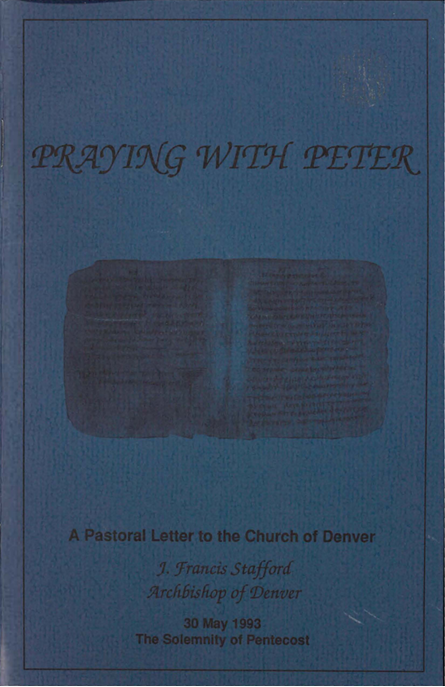
The Bodmer Papyrus, a Greek transcription of the Epistles of Peter, dates to the third century and is the oldest documentation of Peter's first century letters to the faithful.
The page on the right hand opens Peter's second letter, “From Simon Peter, a servant and apostle of Jesus Christ, to those who have obtained a faith of equal standing with ours in the righteousness of our God and Savior Jesus Christ…”
The Bodmer Papyrus was given to Pope Paul VI who entrusted it to the Apostolic Vatican Library in 1969.
”Vatican Treasures: 2000 Years of Art and Culture in the Vatican and Italy,” a Colorado History Museum exhibition being shown in conjunction with World Youth Day 1993, includes these pages of the Bodmer Papyrus.