In the Beginning the Word Part 3: The Way of the Pilgrim
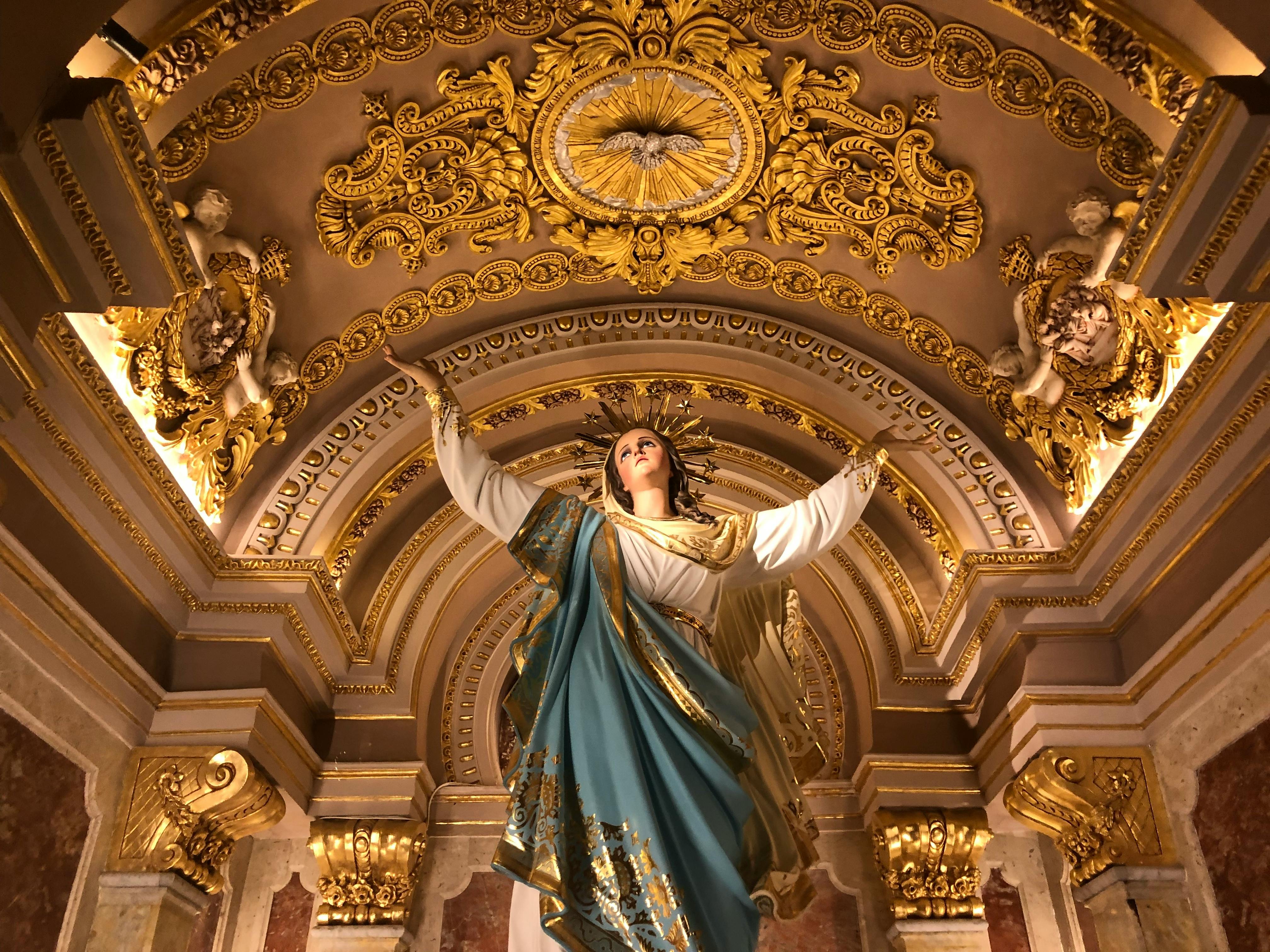

SOLEMNITY OF THE ASSUMPTION OF MARY
15 AUGUST 1995
“The renewal of catechesis in the archdiocese should be founded on the four ancient rules or canons of faith: the canon of Sacred Scripture; the canon of baptismal creeds; the canon of Eucharistic prayers; and canon law...[W]e should pray and work for a doubling of the number of students, grades 1-8, under formal religious instruction [and] quadruple the numbers in grades 9-12 by the year A.D. 2000. Even larger goals should be envisioned for those in adult religious education programs [and] campus ministry programs. In the Archdiocese of Denver, I believe we should work to attain a level of 90 percent of our children under formal religious education...
"By A.D. 2000, the number of those confirmed should approximate the number of baptized according to the appropriate age and year...The tripling of the number of seminarians in theology should be the subject of special prayer and activity during this advent of grace opening up to the third millennium…The Christian family should increasingly become the focus of the mission of the parish and the archdiocesan Church…By the year A.D. 2000, we should pray and strive to reverse the drop in Church marriages.”
“The Continued Renewal of the Archdiocese of Denver: Eleven Points for Action”
J. Francis Stafford, October 1991
FOREWORD: RELIGIOUS EDUCATION AND THE TASK OF RENEWAL
“The Way of the Pilgrim” concludes the three-part pastoral letter on Catholic education which I began earlier this year. Religious education, the focus of this final segment, is simultaneously the most important and most challenging subject matter for our reflection.
Important, because ongoing religious education (or, more properly, catechesis) is at the heart and source of renewal in the Church. It embraces a very wide range of services, from children's First Penance and First Eucharist classes, to youth ministry, to adult faith-formation and sacramental preparation. In a sense, even Catholic schools are a subset of the Church's larger catechetical ministry.
Challenging, because the diversity of these efforts precludes a single, all-inclusive blueprint for their success. It is not the goal of this pastoral letter to prescribe or discourage any particular method of teaching the faith. The archdiocese is blessed with a talented and capable Secretariat for Catholic Education, to which such practical issues are entrusted. Rather, I wish to share the guidance which the Church provides in a rich variety of foundational documents on religious education. These have formed me in my own role as teacher. They are a source of encouragement to all believers.
My growing conviction is that the manifestation of God's love in the pierced heart of Jesus is also the manifestation of God's glory—and thus, of His beauty. The challenge of our finite human freedom is to perceive in faith the glory and beauty of God revealed in the face of the Crucified Christ. A study of the self-expression of the glory of God should be the opening approach for modern catechetics.
In preparing my thoughts for this final stage of my pastoral letter, I reviewed the “Eleven Points for Action” I proposed in 1991 as an agenda for renewing the archdiocese. Looking back can be a bracing experience, because we rarely accomplish all we set out to do. On the other hand, four years in the life of an archdiocese is barely a heartbeat, and real change, the kind that matters, occurs slowly. Positive signs of that “real change” are now everywhere in the Church of northern Colorado—especially in the growing demand throughout the archdiocese for Catholic education services of all types. This is a source of immense hope and energy as we approach the great Jubilee Year 2000. I owe a special debt of gratitude to the many catechists whose selfless dedication has helped to make this renewal possible.
The “Way of the Pilgrim” is not an idle image. If nothing else, it speaks of our need to continually deepen our relationship with Christ, to keep learning our faith and to mature in our understanding of Gospel and Church throughout our sojourn here on earth. Religious education does not stop in grammar school or at Confirmation. Catechesis is not merely a task for children. It is a lifelong pilgrimage.
I. THE WAY OF THE PILGRIM
1. To the people of God of northern Colorado, and to all persons of good will: Greetings in the Lord Jesus Christ!
Throughout history and across many different religious traditions, the image of the pilgrim has captured the human imagination. Every pilgrim carries within his or her heart the whole of our human drama: the dangers of life's journey; the arduous search for meaning; the hoped-for destination of deliverance and joy. Time cannot weaken the power of the pilgrim's story. The 200,000 young people who gathered in Denver from around the globe two summers ago for World Youth Day had exactly the same thirst for God that drew generations of Christians to the Holy Land five, 10 and 15 centuries ago. Their young faith touched the soul of Colorado Catholics. Their fresh witness became the seed of a local renewal.
2. Earlier this year, as part of that renewal, we embarked on a pilgrimage together—a journey not to Jerusalem or Lourdes, but into the heart of our identity as a community of faith; a journey to rediscover and reaffirm the God who created us. As we have already seen, the Church offers us a compass for that journey: Catholic education. The task of Catholic education is to guide us along life's road to God. It must lead us into the presence of the Crucified Christ, who is Truth itself—and then beyond Golgotha to the joy of the Paschal garden on Easter morning.
3. Thus we began in March with Part One: Signs of the Times, which examined the basic principles of Catholic education. We continued in May with Part Two: Living Stones, explaining the vital role of Catholic schools as transmitters of the Gospel.
4. Today, by reflecting on religious education (or, more accurately, “catechesis") on the Solemnity of the Assumption, we reach an end to our pilgrimage but also a new beginning. An end, because words must eventually fall away; a beginning, because actions must now take their place. Mary, the Mother of God, was preserved immune from the corruption of the tomb, and her earthly life was transformed at the Assumption into an eternal life with God. In like manner, our discussion of Catholic education must now be transformed into new lives of active service to Christ which, by their witness, will give testimony to the words in our religious textbooks. The time has come to put the teaching of this three-part pastoral letter into practice throughout the archdiocese and in the local parishes which comprise it.
II. IN THE WORLD, BUT NOT OF THE WORLD
5. The ideas which undergird Catholic education challenge the mind and excite the heart. But ideas are the easy part of life's pilgrimage. Living them in an unfriendly environment is quite another matter. Today, even the finest Catholic schools soon send their students into a world which bears little resemblance to the community modeled by the Holy Family. Most Catholic young people never enroll in a Catholic school. They attend the same heavily secularized public schools as their non-Catholic neighbors. They thus have an urgent need for a strong education in the faith and a living encounter with Jesus Christ.
6. Additionally, we make a serious mistake if we restrict our understanding of “Catholic education” merely to children and young people. The young represent the future of the Church, but no believer should ever stop learning his or her faith. Adults in general ("Catechesis in Our Time,” Catechesi Tradendae, 43), and parents in particular ("On the Family,” Familiaris Consortio, 8–9; 21; 36–39), have an ongoing need to refresh and enrich their understanding of Church teaching. Adults are the leaders. They are the models. And parents have a special responsibility to be the primary religious educators of their children. By their daily actions, they have far more influence over the next generation than any classroom instructor.
7. In Colorado, we have a special obligation to more effectively implement our Hispanic pastoral plan and to improve our catechetical outreach to the many Spanish-speaking people of the archdiocese. Nor can we overlook those who struggle with unique mental, physical or emotional challenges, and those burdened by the special cross of grief, divorce, long-term illness, prejudice or unemployment. Christ is God's most precious gift to us and the source of our joy. Thus we should share Him eagerly—especially with those whose suffering is the greatest. This is particularly important today. We live in an age which has blinded itself to the redemptive power of suffering and which pushes the weak and the “unwanted” among us to the margins of humanity.
8. In doing so, the world engages in an aggressive, pervasive counter-education that attempts to reduce the Gospel to private piety. As George Marsden demonstrated in his 1994 book, The Soul of the American University, much of higher education in the United States today has moved beyond the standard anti-Catholicism of the 19th and early 20th centuries. Instead, it now rejects any effective Christian presence in academia. As a result, many leaders of contemporary American intellectual life are indifferent to, or actively negative toward, traditional religious faith which is based on the revealed word of God.
9. Such prejudice does not limit itself to the university. It extends to elements of the news media, the cultural establishment and the entertainment industries. Millions of American parents sense that their children are receiving their real education from radio, television and films—and that the “curriculum” is an unsettling one.
10. Traditional religious believers in this country increasingly feel shoved aside. They understand very well the culture-forming power of popular art, music and the major news media. They also see that they have a declining impact on these levers of influence. Whereas once they felt at home in this nation which religious believers helped found and shape, they now often see themselves as “strangers in a strange land,” dismissed as hypocrites and fundamentalists, or cast as dangerous authoritarians when they organize to redress the political balance.
11. The lessons for Catholics are several. For many decades in the first 175 years of the republic, Catholics struggled against bitter religious discrimination. That began to dissipate only after the election of John XXIII as pope and John F. Kennedy as president, and the “opening to the world” which the Second Vatican Council initiated. These events created many positive opportunities in American Catholic life. But Catholics have paid a very high price for entry into the American mainstream.
12. The old Protestant dominance of American society has disappeared. Unfortunately, the “culture of skepticism” which has replaced it is even less friendly to Catholic faith. Today, the Catholic hunger to “fit in” comfortably with American culture, to escape the ghetto separatism of the past, often masks the temptation to forget our religious identity. Too frequently, Catholics forget that they best live their duty of good citizenship by offering to the public a clear, vocal witness of their faith in Christ. We need to be a leaven of Gospel truth in civil society. Private beliefs which have no public consequences are little more than empty promises to God. As St. James wrote, faith without works is dead faith (Jas 2:17). At the same time, however, we should remember that, as C.S. Lewis once observed, nations and civil structures don't have immortal souls—but persons do. Ultimately, saving souls is the task to which the Gospel calls us.
13. For this reason, Catholic men and women should always remember that we are only pilgrims in this life; pilgrims on a journey home to heaven. This can never be an alibi to separate ourselves from those who suffer or to withdraw from the problems of the world. On the contrary, as part of the journey, we have a duty to invite others to join us, because only by loving and guiding and serving others can we reach the happiness of our own final destination. But our time and work on earth are not the goal. They are only the road. Heaven is the goal.
14. The stakes, as Bunyan wrote in Pilgrim's Progress, are high. Because God created us as free daughters and sons, we can freely choose the road to darkness, even at the gates of heaven. But the reward is great for those who revere the Someone who reigns above us: eternal joy for those who encounter Jesus Christ through us; and a share in that infinite joy for ourselves when we finally look upon God, face to face, forever.
15. This then is the heart of the matter: We are in the world, but not of the world—for the sake of the world (Jn 17:6-18).
III. COMPASS AND MAP: THE ROLE OF CATECHESIS
16. John XXIII, one of the most loved popes in our century, is best remembered for convoking Vatican II, the great ecumenical council of renewal. Revered for his openness to all people of good will, Pope John nonetheless frequently and firmly stressed the importance of the Catholic deposit of truth.
17. On the threshold of the opening of Vatican II, in March 1962, he told the parish priests of Rome that “The success of this ecumenical council will lie in the restoration and renewal of the Universal Church. This renewal is summarized in three points: a restored fervor of religious devotion; an extensive and deep renewal of catechetical teaching [emphasis added]; and thus a noble, model and apostolic Christian life.”
18. In the same talk, the pope stressed that “[Teaching the faith] is the constant preoccupation of the Church...This solicitude takes on innumerable forms according to the demands and conditions of various times, but these forms are always one and the same in their basic concern. It is that of breaking the bread of truth for the Christian people in a simple and understandable form which can be retained in the memory and meditated upon, and which can be handed on in the families as their precious heritage.”
19. Words like “catechism,” “evangelization” and “catechesis” may sound alien to the contemporary American ear. Yet they provide the map, or the compass, that guides the Christian on the pilgrimage home to God. We should recall that evangelization is the proclamation of the Gospel to the world. In the words of Pope Paul Vl, the task of evangelization is “the carrying forth of the good news to every sector of the human race, so that by its strength it may enter into the hearts of men and renew the human race” (“Evangelization in the Modern World,” Evangelii Nuntiandi, 18).
20. Catechesis, on the other hand, is the work of inculcating the Gospel ever more deeply in the lives of those who have already heard the Good News and believe (Catechesi Tradendae, 18-20; 26). The task of catechesis is “to reveal in all clarity the joy and the demands of the way of Christ” to those who have already accepted Him (Catechism of the Catholic Church, 1697).
21. Catechesis is rooted in the historic Christian vocabulary of handing on the faith. It applies to the entire enterprise of Catholic education, from sacramental preparation, to youth ministry, to parish religious instruction programs and schools, to adult faith-development classes. The New Testament Greek word katechein, meaning an elementary form of oral instruction, was adopted early on by St. Paul and other Christian writers. Paul used this word almost exclusively to denote the teaching of the deposit of revelation coming from Jesus Christ, the Divine Teacher.
22. In the April 1961 words of John XXIII, “Catechesis is the systematic and complete teaching of the divine revelation handed on in the Church, in order to make it ever better known and applied ever more deeply in personal living...It aims at forming convinced Christians who know their faith and put it into practice...Reflection on the great realities of Christianity summarized in that golden book called the catechism, will certainly lead to the fruit of interior renewal.”
23. Pope John's thoughts on Catholic teaching culminated in his famous comments which opened Vatican II on Oct. 11, 1962. “The greatest concern of the ecumenical council is this,” he told the council fathers, “That the sacred deposit of Christian doctrine should be guarded and taught more efficaciously...The salient point of this council is not, therefore, a discurssion of one article or another of the fundamental doctrine of the Church…which is presumed to be well known and familiar to all. For this, a council was not necessary...[but] it is necessary that this certain and unchangeable doctrine, to which the obedience of faith must be given, be studied thoroughly and explained in the way for which our times are calling. For the deposit of faith in itself, namely the truths which form the content of our venerable doctrine, is one thing, and the way it is expressed is another thing...but nevertheless with the same meaning and the same sense.”
24. Pope Paul VI, who guided both the council and the Church in the years following John XXIII's death, saw the same pressing need to ensure the integrity of Catholic doctrine in a time of immense change. In a 1976 letter to the bishops of the United States, he wrote that, “The future of the Church depends on the wisdom and zeal shown in catechetics. The world says to us today precisely what a group of individuals recorded in the Gospel once said to the Apostle Philip: ‘We wish to see Jesus’ (Jn 12:21). And it is Jesus we must show to the world—Jesus, and no substitute. Hence, venerable brethren, we exhort you to the utmost vigilance in the matter of catechetical content, as you endeavor to point out to children and adults the Way, the Truth and the Life, who is Christ.”
25. Both John XXIII and Paul VI foresaw that perceived differences between “the content of our venerable doctrine” and “the way it is expressed” might—without proper counsel from the Church's chief pastors—result in confusion. In some areas, exactly this ambiguity has come about. The continuing rejection of the Gospel by many powerful forces in the world, despite the openness which has characterized the Church since Vatican II, leads some Catholics to question and even discard certain truths of our faith. This is a grave sorrow, for it fundamentally misconstrues the need of the Church to be a countersign of holiness—in effect, a leaven—within human affairs. Again, we are in the world for the sake of the world. But we are not of the world.
26. Because of this confusion, it becomes more important than ever to build a believing community rooted in the authentic Catholic faith which we find in the magisterium (i.e., the teaching office of the Church, vested in the pope and those bishops in communion with him). To accomplish this, we must anchor all our teaching efforts in reliable guides to Catholic truth.
27. Since the council, numerous pastoral letters and official national and Roman documents have appeared which offer valuable catechetical insights. But foundational are the “General Catechetical Directory” (GCD) released by the Vatican's Sacred Congregation for Clergy in April 1971; Pope Paul VI's apostolic exhortation, “Evangelization in the Modern World” (Evangelii Nuntiandi), issued in 1975; the “National Catechetical Directory: Sharing the Light of Faith” (NCD), released by the National Conference of Catholic Bishops in 1977; Pope John Paul II's apostolic exhortation, “Catechesis in Our Time” (Catechesi Tradendae, hereafter CT), issued in October 1979; and above all the magnificent Catechism of the Catholic Church, released in English in 1994.
28. Nothing substitutes for reading, studying, praying over and discussing these primary sources directly. I ask all religious educators in official ministry within the Archdiocese of Denver to do so in the coming year, and regularly thereafter. We must even more urgently remember that divine revelation (Scripture and Tradition) is the source and object of Catholic faith (GCD 10, 13; CT 27); that Scripture is the soul of theology and catechesis ("Dogmatic Constitution on Divine Revelation,” Dei Verbum [DV], 24); and that all who are engaged in the official ministry of the Word—priests, deacons and catechists—“should immerse themselves in the Scriptures by constant sacred reading and diligent study” (DV, 25). Additionally, “prayer should accompany the reading...so that a dialogue takes place between God and man” (DV, 25). From all these texts, we can draw many useful applications for the purposes of this pastoral letter.
29. First, in my own calling as bishop, I accept and cherish the responsibility emphasized by the pope when he writes that “You [bishops] have...a special mission within your Churches: You are, beyond all others, the ones primarily responsible for catechesis...Together with the pope, in the spirit of episcopal collegiality, you too have charge of catechesis throughout the Church” (CT, 63).
30. I accept in humility the task “to bring about and maintain in your Churches a real passion for catechesis, [accompanied by] the necessary personnel, means and equipment, and also financial resources ... [for you] can be sure that if catechesis is done well in your local Churches, everything else will be easier to do” (CT, 63). I also acknowledge the truth of John Paul II's words when he says that”...although your zeal must sometimes impose on you the thankless task...of correcting errors, it will much more often win for you the joy and consolation of seeing your Churches flourishing because catechesis is given in them as the Lord wishes” (CT, 63).
31. The sensitive issue of “correcting errors” deserves special reflection. As affirmed by the bishops of the United States in 1977, “the bishop holds the primary position of authority over programs of catechesis...[and the] teaching of what is opposed to the faith of the Catholic Church, its doctrinal and moral positions, its laws, discipline and practice, should in no way be allowed or countenanced in catechetical programs at any level” (NCD, 47). The bishops continue that “Catholics should always measure their moral judgments by the magisterium...for the Church is the indispensable guide to the complete richness of what the Church teaches” (NCD, 190). Moreover, “[c]onscience, though inviolable, is not a law unto itself; it is a practical dictate, not a teacher of doctrine. Doctrine is taught by the Church, whose members have a serious obligation to know what [she] teaches and adhere to it loyally” (NCD, 190).
32. What this means in practice is that, to ensure the teaching of the truth about Jesus, I am directed by the Church and I accept her commission—to personally preach, present and explain the substance of our Catholic faith and to safeguard it against error. I am directed by the Church to ensure that correct catechetical instruction, i.e., instruction faithful to the Church's historic deposit of truth, is available for all Catholic people in northern Colorado ("Dogmatic Constitution on the Church,” Lumen Gentium, 25)
34. Most importantly, as bishop, I want to encourage and support my people, the people of the Archdiocese of Denver, whom I love as my family in faith. I join my own voice to the pope's in wishing to “set hearts aflame” and to “sow courage, hope and enthusiasm abundantly in the hearts of all those many diverse people who are in charge of religious instruction and training for life in keeping with the Gospel” (CT, 62).
35. As John Paul writes, “All believers have a right to catechesis, and all pastors have a duty to provide it” (CT, 64). I therefore urge my brother priests of the archdiocese—but especially pastors, who have in their spiritual care whole communities of faith and who share in my teaching authority as bishop—to join eagerly in this task of deepening our people in their Catholic identity. I ask them to ensure a vital, authentic Catholic sacramental life in their parishes, with lively instruction in right doctrine and a call to charitable action. The homily is an especially vital tool in this work (CT, 48). I also invite women and men religious serving in the archdiocese to join in the renewal of Catholic apostolic life. Many bring unique skills from years in the teaching apostolate. And even those not engaged in a formal educational ministry “teach” through the quiet witness of a faithful vocation of service (CT, 64–65).
36. Finally, it is the lay faithful on whom much of the future depends, and whose ongoing education in the faith concerns me especially. As John Paul II wrote in his 1988 apostolic exhortation, “The Vocation and the Mission of the Lay Faithful” (Christifideles Laici [CL], 3), “A new state of affairs [exists] today, both in the Church and in social, economic, political and cultural life, [which] calls with a particular urgency for the action of the lay faithful. If a lack of [Christian] commitment is always unacceptable, the present time renders it even more so.”
37. A believer's growth in Jesus Christ cannot end with childhood. We should remember that Jesus’ first disciples were adult men and women who sat at His feet to grow in knowledge of who He is. Zacchaeus even climbed a tree to catch a glimpse of Him (Lk 19:4). Today, meeting the challenges and opportunities of modern society requires “a total and ongoing formation of the lay faithful” (CL, 57). As a result, “formation [in the Catholic faith] is not the privilege of the few but the right and duty of all” (CL, 63)—and not merely until adolescence, but throughout life.
38. Parents are key to this process, since they first cultivate the habit of learning. Even in Catholic schools, as I noted in Part Two of this pastoral letter on education, Living Stones (32), parents remain the primary catechists of their children. But for the many Catholic children who will never attend a Catholic school, parents become even more decisive in the transmission of the faith—which means that parents, too, must have opportunities to constantly enrich their grasp of Church teaching (CL, 62). The pace of modern change has turned society into a vast wind tunnel that carries off everyone and everything not firmly grounded on bedrock. The family must become, again, the bedrock for Catholic spouses and children. In turn, the parish must become the bedrock for families and Catholic singles and persons with special needs.
39. As Americans, we take great pride in the ever increasing speed of our progress, our mobility and our technological sophistication. But, without the guiding light of the Gospel, these things are mixed blessings. They can just as easily disrupt community—turning us inward on ourselves and dividing and isolating us—as they can bring us together. In the coming decades, the parish will be the glue that holds the believing community together as a visible body. Thus, a unified vision of “total parish education” (Archdiocese of Denver Pastoral Handbook, 3,4,9) should become the norm.
40. Just as a parish is a believing community and a sacramental and liturgical community, so it must be an evangelizing and catechizing community. These are essential activities for every parish and for each of its members. Prayerful discussion and study of the Church's liturgical year—with its wonderful progression of feasts, seasons and traditions—can provide a powerful foundation for these activities.
41. As Vatican II noted, “In the course of the year...[the Church] unfolds the whole mystery of Christ from the incarnation and nativity to the ascension, to Pentecost and the expectation of the blessed hope of the coming of the Lord. Thus recalling the mysteries of the redemption, she opens up to the faithful the riches of her Lord's powers and merits, so that these are in some way made present for all time; the faithful lay hold of them and are filled with saving grace” ("Constitution on the Sacred Liturgy,” Sacrosanctum Concilium, 102). Given the beauty and richness of the Church's liturgical year, I urge parents, pastors and catechists to make effective use of the annual liturgical calendar produced by the archdiocese as a valuable teaching tool.
42. The pastor, acting with the local bishop's teaching authority, is chief catechist of his parish community. He should therefore promote the integration of resources and the sharing of facilities between the parish school (if one is present or planned) and parish catechetical programs. He should also encourage cooperative relationships among Catholic families, the school principal and faculty, and the parish catechetical director and catechists, because all of these persons do the same, equally vital, apostolic work (CT, 66-69). For unity to be fruitful, we must all teach and worship as one. Thus, parish catechetical programs deserve a serious commitment of time, talent and treasure.
43. A crucial agent of parish unity must be the parish catechetical director (or DRE). The DRE must guarantee the quality of teaching and the authentic doctrinal content of parish catechetical programs. She or he is also a delegate of the bishop through the local pastor and is responsible to the pastor for effectively implementing the bishop's catechetical efforts among all age groups in the parish. Because of the pivotal work involved with this apostolate, every DRE should be marked by a zeal for the Gospel, a striving for personal holiness, a thorough knowledge of Catholic doctrine and a joyful obedience to Church teaching and the local bishop.
44. Therefore, I charge the secretary for Catholic education, assisted by the archdiocesan director of catechetics, to review, evaluate and continually improve the formation and certification process for all archdiocesan catechists. We should remember that the purpose of the formation-certification process for catechists is to (a) inculcate a rich understanding of authentic Catholic doctrine and a spirit of service to the local bishop's ministry; (b) provide a solid grounding in Christian anthropology and effective teaching methods; and (c) encourage a deep love for the Church and an enduring encounter with Jesus Christ—not only intellectually, but personally, at the level of the heart.
45. In that regard, I direct the secretary for Catholic education, through the Office of Catechetics, to review, study and adapt the insights of the 1993 “Guide for Catechists” issued by the Vatican's Congregation for the Evangelization of Peoples. While this document is not addressed to the Churches of the developed world, it is nonetheless rich in wisdom about the choice and formation of candidates for the vocation of catechist. Moreover, as I noted in my pastoral letter Part One: Signs of the Times, the emerging culture in the United States is increasingly ignorant of the Gospel. Our nation becomes, with each passing year, a new kind of mission territory that requires not just catechesis but evangelization.
46. I charge the secretary for Catholic education—again, with the support of the director of catechetics—to review and evaluate all catechetical guidelines and programs of the archdiocese. Further, the secretary should develop and implement new ones where appropriate. The content of these guidelines and programs should in all cases be grounded in the Catechism of the Catholic Church and the GCD, as well as Pope Paul VI's superb Creed of the People of God, issued in 1968. Programs must be marked by a fidelity to the deposit of the faith, be revelation-based, be Christ-centered and Trinitarian, be focused on intimacy with Jesus Christ, be age-appropriate, and should engage the whole person—body, mind and spirit; intellect, memory and will.
47. A plurality of effective methods, guided always by authentic content, should be encouraged. In all cases, a final decision on the appropriateness of a catechetical text or program is the responsibility of the secretary for Catholic education, assisted by the archdiocesan director of catechetics. I direct the secretary to work closely with textbook publishers to ensure both the ingenuity and the sound doctrine of all catechetical programs used in the archdiocese. The secretary, through the Office of Catechetics, should review, evaluate and approve all catechetical texts and materials throughout the archdiocese on an ongoing basis. I charge all parish directors of catechetics to cooperate fully with the secretary for Catholic education and the archdiocesan Office of Catechetics in this important effort.
48. I offer my heartfelt thanks to all the catechists of the archdiocese, who serve the Catholic people of northern Colorado with such devotion and self-sacrifice. This includes the staff and faculty who labor so diligently to make the adult religious education efforts of the archdiocese continually more effective. I direct them to incorporate the content of my three-part pastoral letter on education into their own programs. In this way, the good work of the archdiocesan Catholic Biblical School, Catechetical School, Mile Hi Congress and Mile Hi Scripture Institute will become even more fruitful. It is my hope that more and more lay people of the archdiocese will discover, through our adult programs, a fresh enthusiasm for the Church and a renewed understanding of their personal vocations as modern apostles who are called to holiness and intimacy with Christ. For it was the Lord's command to us to be apostles, to “go therefore, and make disciples of all nations” (Mt 28:19), which set us on the road as pilgrims in the first place.
IV. "MY SPIRIT REJOICES IN GOD MY SAVIOR"
49. I am concluding this pastoral letter as I begin my 10th year as archbishop of Denver and on the second anniversary of the close of World Youth Day. My heart is filled with many memories and the faces of so many people who have humbled me—without their ever knowing it—by their extraordinary kindness to the Church, to the poor, to the weak, to the suffering, to each other and to me.
50. In an age when controversy seems to dominate every page of our newspapers and spills over even into the life of the Church, my experience of the Catholic people of Colorado has always been, and remains, one of welcome, humor, generosity and service. This is who we are as a people—people guided by the light of Christ, which fills the hearts of those who seek Him. This light is the greatest gift adults can share with each other in fellowship. It is the “pearl of great price” parents give their children. It shows us who we are. It illumines the road home to heaven. But our paramount task is to share this light with others, to “make disciples of all nations,” to pass the truth on to those who follow us. In a gray and turbulent time, Catholic education offers the light of truth. We cannot be satisfied with its survival; we must enable it to thrive.
51. Many times in my priesthood I have returned to the First Letter of Peter, wherein he encourages Christians, despite their trials, to rejoice, “rejoice with unutterable and exalted joy” (1:8). The modern world, so wounded by skepticism and despair, often finds this joy incomprehensible. And little wonder, because joy springs from hope, and hope finds its deepest roots in faith in the Paschal Mystery. The joy, the hope and the faith of the Christian life are embodied in the person of Mary.
52. Mary of Nazareth carried the Word of God within her, not merely in spirit, but in the flesh and blood of her son Jesus. Her “yes” to God at the Annunciation opened the road home to heaven for all of us. Her faith in the trustworthiness of God should fill the life of every believer. Thus, with Mary as our model, it is fitting that we began this three-part pastoral letter on Catholic education on March 25, the Annunciation, the great feast of Mary's faith. It is equally fitting that we conclude it today with her canticle of exaltation and joy, spoken by Mary after her own pilgrimage to the hill country of Judea, and which we find in the Gospel reading from the Liturgy of the Assumption.
“My soul magnifies the Lord, and my spirit rejoices in God my savior. For He has regarded the low estate of His handmaiden. For behold, henceforth all generations will call me blessed, for He who is mighty has done great things for me; holy is His name. And His mercy is on those who fear Him from generation to generation” (Lk 1: 46-50).
53. Brothers and sisters: Our joy is in Jesus Christ alone. Jesus—is the Alpha and the Omega; the beginning—"in the beginning, the Word” (Jn 1:1)—and the end (Rev 22:13). “From generation to generation,” others have gone before us handing down the faith; from Abraham, Sarah and the prophets in the Old Testament, to Peter, Paul and Mary of Bethany in the New Testament, to all the thousands of saints who have come since: Ignatius, Catherine of Siena, John of the Cross, Teresa of Avila. It is our turn now. This is our moment. We have no greater vocation as a people than proclaiming Jesus Christ, teaching Him, loving Him and receiving Him into our lives. This is the heart of Catholic education.
+ J. Francis Stafford
Archbishop of Denver
Solemnity of the Assumption of Mary
15 August 1995